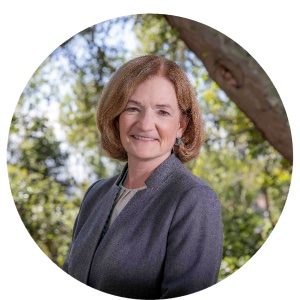
Message from Carol
Dear Colleagues:
As 2025 draws to a close, I reflect on the many challenges the Lab has faced this year. It has not been an easy time, with shifting priorities, budget uncertainties, and reductions in force. I greatly appreciate the commitment and resilience that you have all demonstrated and continue to demonstrate in this environment.
Despite these challenges, we can celebrate each other’s accomplishments. The Director’s Awards ceremony in November provided us with the opportunity to recognize outstanding achievements among our staff. Congratulations to all the awardees, and thank you to all who participated, in person or virtually. Below, we feature three early-career scientist awardees who share some lessons they learned about being successful in a scientific career.
As I have discussed previously in Research News, Berkeley Lab has proven time and again that we have the talent and innovative spirit to evolve with the environment and to thrive. Below, you can read about how AI at Berkeley Lab was built over decades, helping to establish our role as a key player in the DOE’s recently announced Genesis Mission, and positioning us as important contributors for future initiatives.
Across the Lab, I continue to see many new ideas, approaches, and strategies for how to accelerate scientific research. If you have a creative idea for a research project, I encourage you to consider applying for the FY2027 LDRD program, the call for proposals for which was announced on Nov. 19. This year, the deadline for the multi-Area proposals is March 13, while Area Priority and Early Career Development proposals are due on April 17. As many of you know, the LDRD program’s purpose is to encourage innovation, creativity, originality, and quality to keep the Laboratory’s research activities and staff at the forefront of science and technology, while supporting competencies aligned with the Laboratory and DOE’s strategies. You can read about one multi-Area collaboration’s path to the LDRD program.
I would like to thank each of you for your hard work and your commitment to our mission. This holiday season, I hope you can take time to recharge and spend time with your loved ones.
Sincerely,
Carol Burns
Deputy Laboratory Director for Research
Chief Research Officer
Sparking Innovation at Berkeley Lab: An LDRD Award Recipient’s Story
It is Laboratory Directed Research and Development (LDRD) Program proposal season once again. The LDRD Program is one of Berkeley Lab’s primary means of seeding innovative science and new research directions. Its purpose is to encourage innovation, creativity, originality, and quality to keep the Laboratory’s research activities and staff at the forefront of science and technology, while supporting competencies aligned with the Laboratory and DOE’s strategies.
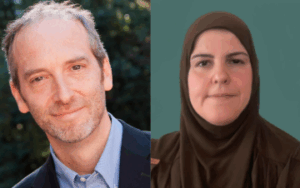
Research News spoke with an FY 2025 LDRD award recipient, John Hartwig, a chemist from the Energy Sciences Area, about his experience submitting for the LDRD award. His research project with co-PI Talita Perciano, a data and computational scientist from the Computing Sciences Area, “Predicting catalyst reactivity and selectivity with structure-based deep learning,” recently concluded.
Early Career Scientist Director’s Award Recipients Share Tips for Success
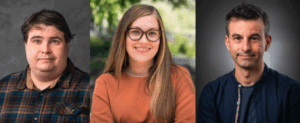
With the recent Director’s Awards celebration, Research News took the opportunity to chat with some Director’s Award early-career scientist recipients about their careers and what they have learned about how to be successful researchers. Scientists Timon Heim (Physical Sciences Area), Kate Zhalnina (Biosciences Area), and Marco Pritoni (Energy Technologies Area) shared their insights.
AI at Berkeley Lab: the Past, the Present, and the Future

Artificial intelligence is everywhere we look — featured in headlines, scientific publications, scientific conferences and workshops, and increasingly in proposal calls. While AI might appear to be a recent phenomenon, its core technologies and methods were built over decades of scientific exploration. Today, researchers across the Lab are continuing this tradition — accelerating AI adoption in science, expanding collaborative efforts, updating research strategies, and supporting key national initiatives, such as the Department of Energy’s Genesis Mission. Moving forward, we must act with speed to realize AI’s promise and help lead the national efforts to accelerate the AI revolution in science.
NEED TO KNOW
Required Review for Research Using “Data from People”
New DOE requirements mandate that all use of “data from people” be reviewed by the Lab’s Human and Animal Regulatory Committees (HARC). HARC has developed a new form to help streamline these required reviews. Submit your research for review using this new form.
After submitting the form, HARC will use the information to make an official determination of whether Human Subjects Research (HSR) regulations apply to your project, and follow up with the next steps if needed.
To learn more about the new HSR determination form and how you can partner with HARC to design and execute your research, visit the HARC website or attend an upcoming informational session:
When: Friday, December 12th
Time: 11:30 am – 12:30 pm Pacific Time
Changes to Foreign National Access Program (FNAP)
The Department of Energy (DOE) has issued changes to the Foreign National Access Program (FNAP), a program that establishes requirements for access to DOE national laboratories by non-U.S. employees, visitors, and others. These changes will directly impact some foreign national research collaborations at the Lab. These new requirements took effect on December 8, 2025. You may need to take immediate action to ensure that upcoming visits and assignments proceed smoothly.
Read about the changes to FNAP.
GOOD TO KNOW
New Support Launching for Mid-Career Scientists & Engineers

The Career Pathways Office (CPO) is launching a new professional development and networking program for all scientists and engineers (S&Es) who define themselves as mid-career. The new program aims to support the group’s unique needs around community-building, visibility, and pathways for success, as identified by a recent needs assessment.
Read on for more program details.
Visit the Career Pathways Office website.
Donate Today to Local Food Banks
This year, food banks are stretched thin due to inflation. Every dollar you donate helps Alameda County Community Food Bank and the Food Bank of Contra Costa and Solano provide much needed meals to our local community. The Lab’s Winter Food Bank Challenge concluded on Dec. 8, but the community still needs you.
Donate to the Alameda County Community Food Bank or the Food Bank of Contra Costa and Solano.

