New and Improved Capabilities will Benefit Users and Berkeley Lab Scientists
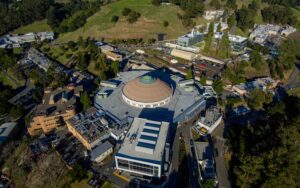
As most researchers at Berkeley Lab know, the Lab is in the midst of a historic modernization of the Advanced Light Source — also referred to as the “ALS Upgrade” or “ALS-U” project. The project will replace the current ALS ring with two rings, as well as update old infrastructure and ensure that it is seismically safe. The upgraded ALS will generate a hundred times brighter, more coherent (“laser-like”) beams of soft X-rays, with significant benefits to science.
The project has already completed the installation of the accumulator ring magnet rafts. The ALS is planning to “go dark” in the second half of 2027, for about two years, in order to build and install the new storage ring. When it re-opens for business, it will accelerate research as well as provide exciting new capabilities that will benefit the ALS user community, including the many Berkeley Lab scientists who conduct synchrotron experiments. (About 15% of the ALS’ 1,600 current users are Lab researchers.)
Many of the current beamlines will remain after the upgrade, and a handful will close, opening new opportunities for developments. Some of the flagship beamlines for the upgraded ALS have already been prioritized, prompting many ALS users and Lab scientists to start thinking about how these new and upgraded beamlines might be relevant to their research. These beamlines will take full advantage of ALS-U’s increased brightness and coherent flux.
MAESTRO: Smaller, Faster Measurements, and Lots More Data
One of the beamlines that will be upgraded, MAESTRO, which stands for Microscopic and Electronic STRucture Observatory, will take full advantage of the improved coherence for condensed matter physics and materials science experiments. MAESTRO measures two-dimensional nanostructures (for example, transistor structures assembled from novel materials) and examines the changes in the electronic structure of those very small devices while applying currents and voltages.
The upgrade will boost angle-resolved photoemission spectroscopy (ARPES) collection efficiency by more than an order of magnitude, enabling much better spatial resolution, faster measurements, and more comprehensive data sets for materials discovery.
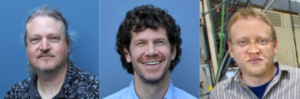
Eli Rotenberg, Chris Jozwiak, and Aaron Bostwick are the beamline scientists for MAESTRO. Eli is also the program lead for ALS beamlines using the ARPES technique.
“To fully exploit the ALS upgrade, MAESTRO’s optics instrumentation will be upgraded, providing between 10 and 100 times more photons and speeding up the experiments. Experiments at the beamline that currently take weeks can be accelerated into days or even hours,” said Aaron.
Chris added, “The increased speed also means that we will be able to take broader sets of measurements. The ALS upgrade will allow our beamline both to take more detailed measurements, and to complete them much more frequently, generating a wealth of information.”
Eli pointed out the benefits of the upgrade to AI: “I’m excited to be able to use this data to leverage AI, visualization, and data mining tools. It opens up many new opportunities to use data to discover previously unknown phenomena.”
He also pointed out that with the concurrent upgrade of the beamline’s optics instrumentation, MAESTRO will be able to look at objects 2 to 3 times smaller (30nm) than currently.
Said Eli, “This beamline is very important for hard materials research – condensed matter physics, materials science (including quantum materials), chemists working with hard materials, and microelectronics, for example. Scientists at the Lab engaged in these areas of research will certainly benefit from these new capabilities.”
“MAESTRO is already the leader in spatial resolution in ARPES experiments; with the upgrade, we will leap forward even further, staying well ahead of others’ capabilities,” added Chris.
COSMIC Imaging: Nanoscale Scanning at Speed
COSMIC Imaging is another beamline that will be upgraded to leverage the full brightness and increased coherence of the upgraded ALS to perform zone-plate-based microscopy, ptychography, and 3D tomography.
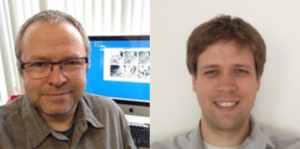
ALS research scientist Alex Ditter manages the ptychography research at the COSMIC Imaging beamline. Hendrik Ohldag is a staff scientist in the ALS’ X-ray microscopy group who currently operates a scanning transmission X-ray microscope at Beamline 11.0.2. He will join Alex at the updated COSMIC Imaging beamline when the upgraded ALS goes live.
Said Alex, “The beamline will get a new monochromator and new adaptive optics that can focus the beam in a new way. The most exciting update is in the ring itself – the 100-fold increase in coherent flux will significantly enhance scanning capabilities and data collection speed. We’ll also have a new detector for ptychography, which will be much faster as well as improve spatial resolution down to a few nanometers.”
Hendrik, who works a lot with battery researchers, provided an example: “Today, examining real-life conditions of batteries, such as charging and discharging thousands of times to discover their point of breakage, would not be possible with today’s beamline; it would just take much too long. But we’ll be able to run these realistic experiments after the upgrade.”
Alex often works with dilute samples. He pointed out that the upgrade facilitates fluorescence techniques, which can detect signals from even a few atoms. “Fluoresence imaging has potential applications across various fields, such as battery materials, catalysis, and magnetism, and even life sciences,” said Alex.
Alex has been working with the Lab’s heavy element chemistry group and Earth and Environmental Sciences researchers, but he believes that anyone who’s interested in nanoscale chemical contrast in their samples, for example battery materials catalysis researchers, could benefit from the beamline’s capabilities. Hendrik agrees, noting that scientists in materials sciences, chemical science, geoscience, and earth and environmental science, might be interested.
Said Hendrik: “With the upgrade, we will be able to look at a lot more samples, instead of focusing on a few representative images as we do now. We can also then compare our results much easier and more comprehensively with other characterization tools such as transmission electron microscopy (TEM). This expands scientists’ ability to conduct systematic studies of chemistry, magnetism, and structural changes on the same time scale. I’m really looking forward to that.”
Alex said, “I’m quite excited about the potential to conduct experiments at a faster rate and with the new scanning device. You can see things as they are happening, at the nanoscale. I expect we’ll have the ability to observe phenomena such as spin flips in spin ice patterns (important for understanding magnetic properties, quantum phenomena for applications such as quantum computing and advanced magnetic storage) and battery material changes in real-time at the nanoscale.”
“Soft x-ray microscopy research with magnetism and chemistry is already a special capability at the ALS. The upgrade will really put us in a position to provide unique services to scientists,” added Hendrik.
FLEXON: Coherent Scattering Capabilities for Quantum Materials Research

In addition to MAESTRO and COSMIC Imaging, additional beamlines have been prioritized as future development opportunities.
A future new beamline, dubbed FLEXON, will house a chamber for coherent scattering experiments. The chamber is currently hosted at the COSMIC beamline, but after the upgrade will move to a new location. Quantum materials’ unconventional properties are dominated by quantum mechanics, and their heterogeneity, or non-uniformity — such as structural defects, impurities, boundaries, surfaces or variations in composition — which can be challenging to explore. FLEXON will enable characterization of nanoscale electronic and magnetic fluctuations and their interactions that can give rise to exotic charge and spin textures that profoundly influence material properties.
“Increasing coherence is making the light more like that of a laser compared to that of a light bulb,” explained Sophie Morley, a research scientist for the beamline. “The boost in coherence with ALS-U significantly increases the beamline’s spatial and temporal resolutions, facilitating faster dynamic measurement of quantum materials as they change, and closer to the point where the changes are occurring. This is a pretty exciting improvement that will allow us to better understand phase transitions and driven dynamics in quantum materials,” she added.
Said Sujoy Roy, program lead for the Coherence and Magnetism program at the ALS, “With the low-temperature capability, in-situ magnet, and a fast new Timepix camera that is literally state-of-the-art, we’ll be able to offer unique capabilities to researchers studying nanoscale electronic and magnetic properties of materials.”
The scattering chamber’s capabilities will be of most interest to condensed matter physicists and other materials scientists at Berkeley Lab who want to examine hard materials at low temperatures, such as magnetic materials, ferroelectrics and superconductors.
TENDER: Unique Capabilities at Intermediate Energy Levels

Another new beamline that has been prioritized for future development will feature medium-energy, or “tender” x-ray capabilities. The Tender beamline will have both imaging and scattering capabilities like the COSMIC and FLEXON beamlines, the primary difference being the energy range. COSMIC, which covers soft x-rays from 250 to 2500 eV can provide high spatial resolution with chemical sensitivity, but soft x-rays have limited penetrating power which limits the sample thickness that can be effectively measured (about a hundred nanometers or so at the lowest energies). The Tender beamline will cover energies from 2.1 to 8 keV; this energy range provides chemical sensitivity to the same elements as COSMIC but uses higher photon energies which can penetrate more material, up to tens of microns. ALS senior scientist David Shapiro and staff scientist Greg Su will be working with the Tender beamline, with David on imaging experiments and Greg on scattering research.
With the new low-emittance storage ring of the ALS upgrade, Tender will provide up to 3 orders of magnitude higher coherent flux than what is possible at the comparable energy range today. Said David, “The impact of this sort of gain cannot really be understated and to put it in perspective, a previous major improvement to the ALS yielded something like a factor of 2 increase in average brightness, and that was already very exciting! We know that it means we can measure 1000 times faster, but it’s hard to process what that even means for our work. This will require the development of automation tools, both robotics and AI, so that we can accelerate discovery to the level the new source allows.”
“We can also achieve spatial resolution 5X higher than what we get today, which is already around 10nm. Measuring chemical phases with 2 nm spatial resolution will open many avenues of research which are inaccessible today,” added David.
According to David, Tender’s imaging capabilities would be of interest to a broad range of scientists, including materials science, energy science, physics, and environmental science. “For example, the environmental science community could study the distributions and compositions of metals in the environment. This could provide information about global nutrient cycles or natural sources of hydrogen, for example. The energy science community is interested in optimizing performance of energy storage and conversion materials; Tender could help them understand the laws which govern ion transport in solids and also the material characteristics which limit it and impact device performance. At Tender, we aim to measure the distributions, compositions and even currents of the active metals, like lithium in a battery or nickel in a catalyst, for example.”
Greg is focusing on the beamline’s scattering capabilities. Said Greg, “With the ALS upgrade’s higher coherent flux, researchers will be able to see how molecules are arranged and how fast they are moving, using the X-ray photon correlation spectroscopy, or XPCS, technique. Although other lightsources around the nation have XPCS capabilities, the Tender beamline’s energy range and elemental sensitivity will be unique.”
Said Greg, “The Tender beamline’s coherent scattering capabilities will probe structure and dynamics with chemical sensitivity. Tender x-rays are sensitive to various elements, including phosphorus, sulfur, potassium, calcium, and various transition metals. This will open up research opportunities for polymers, electrochemical materials for applications like fuel cells and electrolyzers, biological systems, and environmental samples.”
“I’m really excited about the new opportunities that will emerge from the Tender beamline’s ability to combine chemical sensitivity with spatial and dynamic information. This combination could be quite transformative across different fields of science. It will take time to reach this potential, but we’re looking forward to building these capabilities and developing techniques that can serve a broad range of research,” added Greg.
Future Beamlines for an Upgraded ALS
These beamlines are just among the first to be prioritized for the new ALS. Ashley White, deputy for strategy for the ALS, said that the ALS will issue proposal calls in the future for additional beamlines as opportunities open up. She said, “We regularly engage our user community in understanding their scientific needs through our User Meeting and dedicated workshops. While the ALS is dark, we plan to engage Lab scientists and our external user community in future planning for new science and capabilities.
“We’re also providing resources to our user community as a whole, including Lab scientists, on other light source facilities with similar capabilities that could be leveraged during the ALS dark time,” added Ashley. “In a few limited cases, ALS beamline scientists may be able to spend time at other facilities continuing collaborations and collecting data on behalf of ALS users.”
The ALS is one of a small number of X-ray light sources that are very important to the national research enterprise. As Lab Director Mike Witherell said in a recent Elements story, “I believe that no set of scientific facilities in the nation have broader impact than the X-ray light sources. This upgrade helps ensure the U.S. maintains its world-leading scientific capabilities in an environment that’s increasingly competitive, and we are part of that. We have to keep up with this new generation of light sources here and around the world to keep up with science. That’s why we need to do ALS-U.”
For more information:

