Quantum technologies, which have the potential to revolutionize science, are an area of growth, with the DOE investing more than $1.6 billion in quantum information sciences and technology since 2019. The need for a skilled workforce in the field continues to grow, yet with the numbers of trained scientists and engineers lagging behind demand, the number of unfulfilled job vacancies increases every year.
Berkeley Lab’s Academic Learning Internships and Faculty Training (A-LIFT) Office recognized this growing gap about five years ago and partnered with Sandia National Laboratories to develop a workforce plan. The goal was to introduce students and educators to the topic, so that they have a better understanding of what the science is about, and possible careers they might consider. 11th and 12th graders, in particular, who are making their next career and education choices, were an important audience to get in front of.
Said A-LIFT Director Faith Dukes, “Most high school students don’t get exposed to quantum information and science technologies, and they don’t have a good idea of how they can be a part of the quantum workforce. We’ve been working hard to fill that gap.”
Introducing Students to Quantum
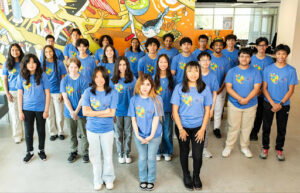
To this end, Berkeley Lab has been running the QCaMP (Quantum, Computing, Mathematics, & Physics) summer program since 2022 in collaboration with Sandia National Laboratories. To date, 100+ students have participated in the program at Berkeley Lab.
The program is a direct workforce effort of the Quantum Systems Accelerator (QSA), a DOE National Quantum Information Science Research Center led by Berkeley Lab in partnership with Sandia National Laboratories. In 2024, the one-week student program expanded to four weeks and became an Office of Science Workforce Development for Teachers and Scientists (WDTS) Pathway Summer School for Students. This year, 40 students in California and New Mexico will come onsite for four weeks at each lab to learn about fundamentals in physics and math for quantum and computing. Researchers at both labs will be contributing as lecturers and facilitators on topics like quantum algorithms, sensing, optics and materials.
“Exposure to quantum science and related areas is key. From many of our programs, we have found that students who are exposed to a particular science or research area have a higher likelihood to major and/or pursue a career in that area,” said Faith.
To broaden access, student applicants need not have taken Advanced Placement math prerequisites, just algebra. The rest of the math required to explore quantum science, like matrices and linear algebra, is introduced via a “just-in-time” teaching method within the program.
Recognizing that quantum science skills are needed at all levels, not just at the Ph.D. level, Berkeley Lab is also working with Berkeley City College (BCC) on a “quantum boot camp.” In late July, 20 BCC students will embark on a three-week experience that will combine lectures in fundamental concepts with technical workshops and engagements with industry partners. Students are expected to get a better understanding of the field, with an eye towards opportunities that are available in the workforce now.
Educating the Educators
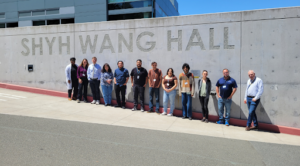
Because helping educators teach their students about quantum sciences can multiply the impact that A-LIFT can have, educators are another focus for QCaMP. Since 2022, A-LIFT has hosted a summer Quantum for Educators program. With the leadership of Sandia National Laboratory and Berkeley Lab support, the program has expanded; this year, the educator program will take place in 15 states, with close to 200 teachers (10 at Berkeley Lab) participating in hybrid online and onsite sessions hosted by several national labs and universities.
During the week-long program, teachers will learn ways of introducing quantum sciences in their classroom in conjunction with the standards they are required to teach. They will get an overview of what quantum is as well as explore lesson plan development, facilitation, and implementation. They will also make connections with scientists so that their classes can visit national labs in person during the school year or invite researchers to their classrooms. Most of the Berkeley Lab 2025 participants returned to the Lab with their students this school year or to take part in additional professional development days.
Impact
QCamp helps me to link my regularly taught chemistry fundamentals with practical application and newest development in the quantum field. My students are just like many other highly competitive students. Their learning depends highly on applications, and the reason why they need to know certain information. The curriculum that QCamp provides requires every bit of student focus and attention to solve a puzzle and [use critical thinking] to solve problems. ~2025 QCaMP educator participant
Faith has seen firsthand the impact that the programs are having on building a quantum workforce. A 2024 participant, whose interest was piqued when she attended the program, reported that she is now applying to the quantum program at a community college in Southern California. Another student started a nonprofit, Girls in Quantum, to communicate about quantum to girls interested in STEM. A teacher who implemented their first quantum lesson plans during the last school year has ideas about how to improve and build upon those lesson plans in future. Another who participated in last year’s educator program wants to return as a QCaMP teacher instructor.
Help Introduce the Next Generation to Quantum Computing
Faith emphasizes that the success of these programs relies on the expertise of our research community. A-LIFT is currently seeking instructors to help support the student, educator, and community college programs. Lab staff who are willing to lead a module (already developed) or help facilitate a hands-on workshop should contact Faith at fmdukes@lbl.gov.
Said Bert de Jong, director of the Quantum Systems Accelerator, “I really value the chance to connect directly with the next generation of quantum scientists, show them what it takes to be a researcher, and help them see the opportunities before them in the quantum ecosystem.”
QCaMP for students and educators has been supported by the U.S. Department of Energy, Office of Science, Office of Workforce Development for Teachers and Scientists (WDTS) under the Pathway Summer Schools for Students and Pathways for Educators Pgrams, respectively.
Fore more information:
Newscenter story, “What to Expect: A-LIFT Office Empowers Lab’s STEM Ecosystem”
Newscenter story, “The Quantum Systems Accelerator Embarks on Next Five Years of Pioneering Quantum Technologies for Science”

