In late July, 37 high school students participating in Berkeley Lab’s Academic Learning Internships and Faculty Training (A-LIFT) program gathered to celebrate the culmination of their summer research experiences. A-LIFT, formed in FY2026 through the merger of the Lab’s Workforce Development and Education (WD&E) and K-12 STEM Education programs, oversees the Lab’s student and educator engagement programs.
This summer, 19 students participated in QCaMP (Quantum, Computing, Mathematics, and Physics), 18 students participated in Berkeley Lab Director’s Apprenticeship Program (BLDAP): Interdisciplinary Pathways to Machine Learning and Data Science (IPMLDS), and 11 educators took part in the QCaMP for Educators program. Interns from the Experiences in Research program, which supported 55 high school students, gave oral presentations and attended a closing session with mentors earlier in the day.
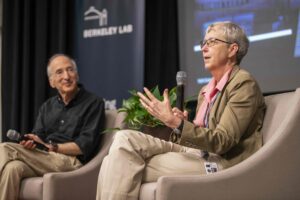
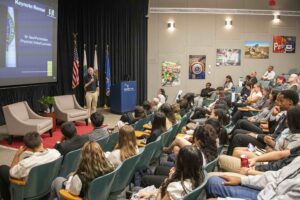
Following a poster session showcasing their work, the A-LIFT graduates gathered in the Building 50 auditorium to hear from Berkeley Lab Director Kathy Yelick and Nobel Laureate Saul Perlmutter. A-LIFT’s Director Faith Dukes and Content and Instruction Manager Alisa Bettale hosted the event and introduced the speakers.
In his opening remarks, Saul challenged the students to think like scientists, offering four pieces of advice:
- One of the biggest challenges for a scientist is to come up with a really good research question that excites you and that will carry you through the inevitable ups and downs of research.
- It’s important to stick with problems long enough to actually solve them.
- Modern day science is surprisingly often a team sport. It’s important to develop your interpersonal skills and networks–and have fun with your teammates!
- A large fraction of scientific activity is hunting for mistakes: from the trivial errors and uncertainties in the data to the big moments when, for example, we realize we misunderstood gravity!
Kathy echoed Saul’s emphasis on team science. “Today’s big societal challenges require a diversity of perspectives,” she said. “You need to be able to work with all kinds of people.”
Using AI as a Tool for Science
Asked about AI’s impact in science, Kathy said that she is looking forward to an acceleration in scientific discovery but also noted the importance of using it responsibly. She raised questions about how researchers will validate results generated by AI systems.
Saul drew a parallel to the rise of high-performance computing during his career in cosmology. These new computational tools in the past and the current generation of AI tools offer the possibility of enabling scientists to pursue questions that were previously impossible to answer. So one job of the scientist is to recognize these new opportunities as they arise. But still the challenge remains of identifying the questions that excite you as a scientist, he said.
Skills Needed to do Science
Both speakers emphasized that computational and AI skills are becoming increasingly important, but neither replaces a strong scientific foundation. Saul said researchers still need a solid understanding of statistics, probability, computation, and their scientific discipline in order to evaluate whether AI-generated results are meaningful.
Kathy encouraged students to build a strong mathematical foundation. “Take more math. You never know how that foundation will help you,” she said. She also encouraged the students to stay curious. “Be inquisitive. Ask people what they are working on,” she added.
Kathy also encouraged students to stay open to unexpected opportunities. “No one in my family was a scientist. My mom was a stay-at-home mom, and my dad worked at the phone company. I started college not knowing what to study, but I discovered that computer science was really fun – it was like solving puzzles.”
Her message resonated with participants. One QCaMP student reflected, “QCaMP has made me want to pursue physics in the future because I could see something I enjoy—math—being used to understand abstract ideas while also being applied to the physical world.“
Audience members asked about topics ranging from the expansion of the universe and the environmental impacts of data centers to balancing hard work with personal well-being. Kathy advised, “Don’t waste time on things that aren’t important.” Saul, who plays violin in a string quartet, encouraged students to make time for family, friends, and interests outside of science. “It’s important to be a healthy and well-rounded person—and surprisingly, it helps the science, too,” he said.
Wrapping up the event, Faith encouraged students to continue their STEM journeys through A-LIFT’s college-level programs and invited educators to explore additional professional development opportunities. She reminded participants that it was not “goodbye” but rather, “see you again soon.”
BLDAP and QCaMP for students and educators have been supported by the U.S. Department of Energy, Office of Science, Office of Workforce Development for Teachers and Scientists (WDTS) under the Pathway Summer Schools for Students and the Quantum Systems Accelerator.
For more information:
- A-LIFT website
- “A-LIFT Helps Build a Quantum Computing Workforce,” Research News, May 2026 issue
- “What to Expect: A-LIFT Office Empowers Lab’s STEM Ecosystem,” Elements, January 23, 2026

